An AI draft should not travel straight from a chat window into a CMS. A safer workflow separates the brief, evidence, generation, human revision, quality checks, and final handoff. That makes each decision visible and gives an editor a practical place to stop unsupported claims before publication.
This article demonstrates that process with a fictional but reproducible project: an editor is preparing a guide called “How to Review an AI-Assisted Article Before Publishing.” The project and outputs below are examples, not customer results. No ranking, traffic, or conversion improvement is claimed.
The Workflow at a Glance
The demonstration uses six controlled stages:
- define the reader, task, scope, and acceptance criteria;
- assemble a small source log before drafting;
- choose a prompt for a specific stage rather than asking for a finished article in one step;
- generate a draft that distinguishes supplied facts from open questions;
- perform human factual, editorial, structural, and rendered-page QA;
- export editable CMS blocks with a short handoff record.
The SEO & AI Content Operations Starter Kit packages these stages as reusable worksheets, prompts, SOPs, and CMS templates. You can also reproduce the method with your own documents; the important part is the separation of responsibilities.
Step 1: Start With a Brief That Can Reject Bad Output
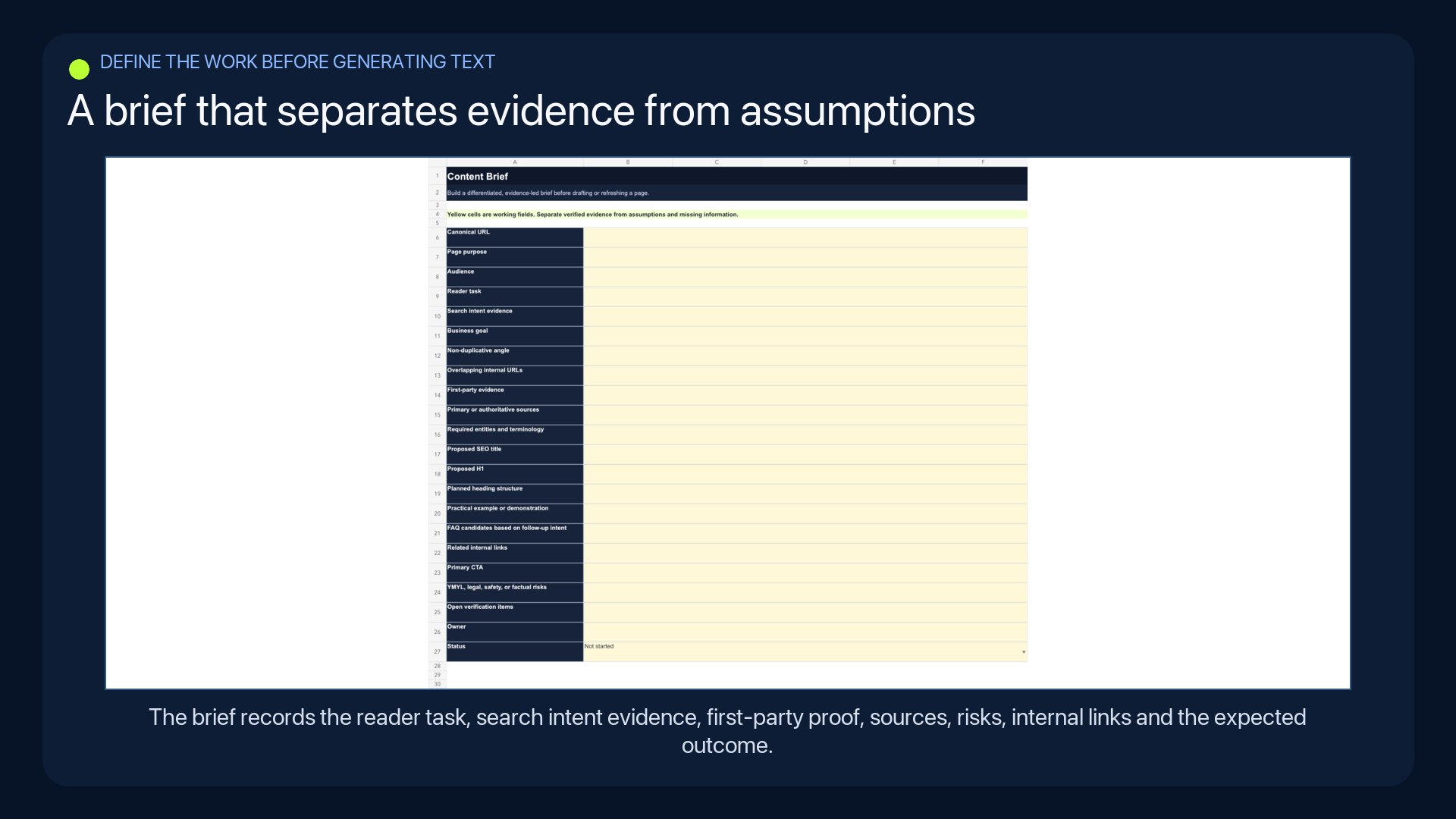
“Write an SEO article about AI content” is not an operational brief. It gives the model no reliable way to decide which audience, task, evidence, or boundaries matter.
For this demonstration, the editor records the following inputs:
| Brief field | Demonstration input |
|---|---|
| Working title | How to Review an AI-Assisted Article Before Publishing |
| Reader | A content editor who already uses an AI assistant |
| Reader’s task | Turn a draft into a reviewable WordPress post |
| Primary answer | Separate evidence, drafting, human review, and CMS QA |
| Required evidence | Current Google people-first content guidance and WordPress block documentation |
| Original contribution | A complete review failure and correction trail |
| Exclusions | No ranking promises, fictional score, or automatic publishing |
| Output | Markdown source plus editable Gutenberg blocks |
| Owner approval | Human editor signs off before publication |
The acceptance criteria matter because they let the reviewer reject an answer that is fluent but incomplete. A draft fails if it invents a result, presents an unsupported policy claim, hides a limitation, loses the source trail, or arrives as uneditable presentation markup.
Step 2: Build the Source Log Before Asking for Prose
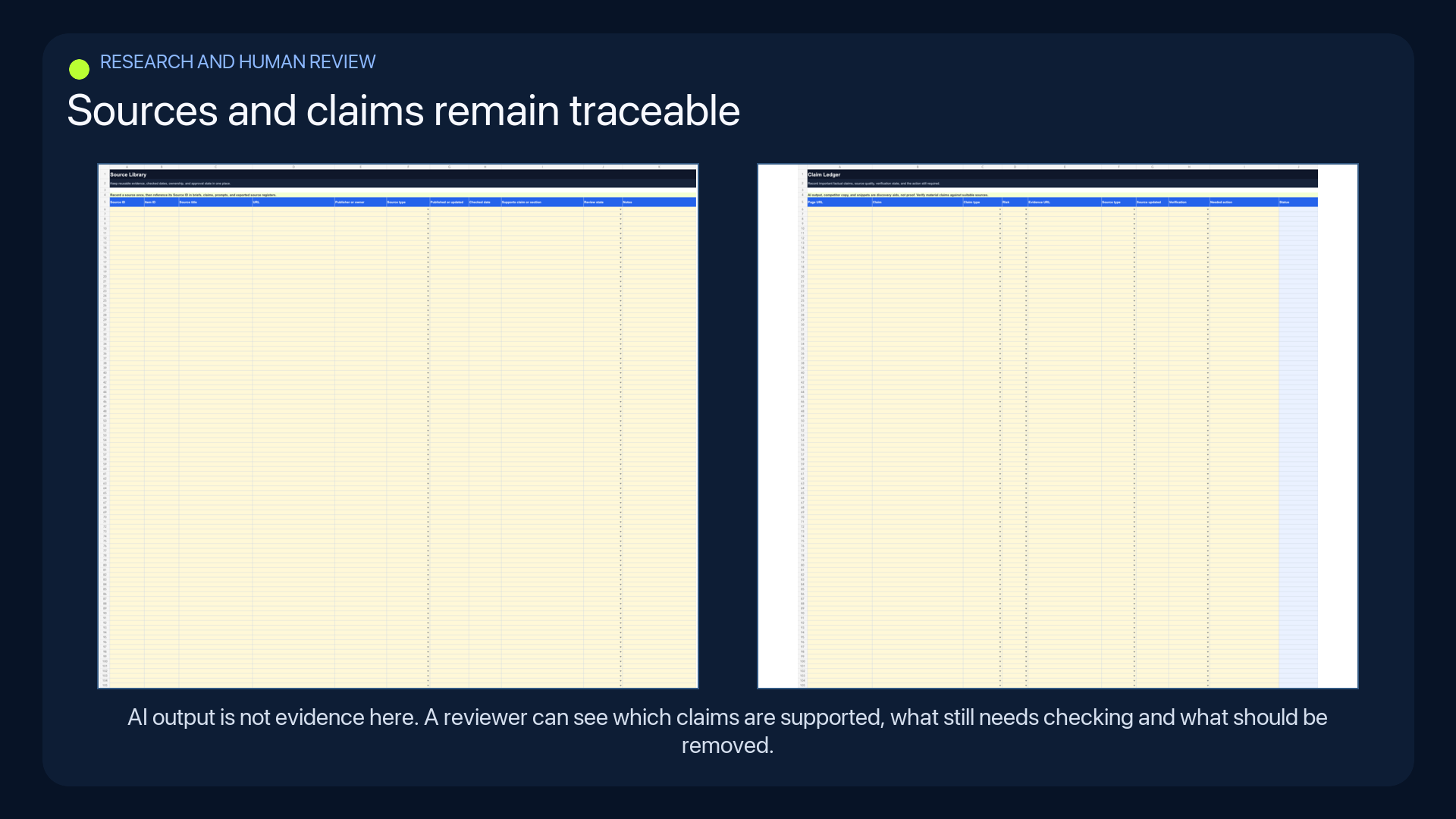
The source log is deliberately small. It records what each source supports and what it does not support.
| Source | Supported use | Do not infer |
|---|---|---|
| Google Search Central: people-first content | Google recommends content made primarily for people and provides self-assessment questions about originality, sourcing, expertise, and reader outcomes | Passing the questions guarantees rankings |
| WordPress block markup representation | Blocks use HTML comment delimiters; WordPress parses that markup into editable blocks | Any arbitrary HTML fragment will behave as a valid block |
| WordPress block data flow | The editor parses stored content into a block tree and serializes edited blocks back into post_content | The CMS has verified the article’s factual accuracy |
The log contains claims, not just URLs. This prevents a citation from being attached to a sentence that the source never supported.
It also exposes gaps early. None of these sources can prove that the workflow improves rankings, prevents every hallucination, or produces expert experience. Those claims stay out of the draft.
Step 3: Select a Prompt for One Job
The editor chooses a drafting prompt, not an autonomous publishing prompt. The input supplied to the AI assistant is:
Create a structured first draft for the recorded reader and task. Use only the claims in the supplied source log. Label anything outside that evidence as “Needs verification.” Include the workflow stages, one realistic QA failure, the corrected version, limitations, and sources. Do not invent results, first-hand experience, or a quality score. Return Markdown for human review; do not publish or call a CMS.
This prompt does four useful things:
- defines the stage as drafting rather than publishing;
- restricts factual material to an explicit evidence set;
- gives uncertainty a visible output state;
- requires an example and limitations instead of generic advice.
A prompt cannot enforce truth by itself. It reduces ambiguity, but the output still needs human review against the sources.
Step 4: Keep the First Draft and the Review Trail
In the demonstration, the model returns this sentence:
Google rewards pages that pass its people-first content checklist, so completing every check should improve the page’s ranking.
The sentence sounds plausible, includes familiar terminology, and is unsuitable for publication. The cited Google page presents self-assessment questions and says its systems use many factors; it does not provide a checklist that guarantees a ranking improvement.
The reviewer records the failure instead of silently deleting it:
| Review field | Recorded value |
|---|---|
| Draft claim | Passing every people-first check should improve ranking |
| Status | Reject |
| Reason | The source does not promise a ranking outcome |
| Corrective action | Describe the questions as an editorial review framework |
| Owner | Human editor |
The corrected paragraph becomes:
Google’s people-first content guidance offers questions about audience, original value, sourcing, expertise, and whether the reader can achieve their goal. Use those questions to challenge a draft, not as a scoring formula or a promise of search performance.
The correction is modest on purpose. It says only what the source supports.
Step 5: Run Four Different QA Passes
One “content score” would hide the decisions that still need review. The editor therefore performs four separate passes.
Factual QA
For each consequential statement, the reviewer opens the cited source and checks the nearby wording. A URL in a source log is not evidence until the claim-source relationship is confirmed.
The reviewer also checks dates and identifies material that may change. If a claim cannot be verified, it is removed, narrowed, or marked Not verified before publication.
Editorial QA
The reviewer checks whether the opening answers the reader’s task, whether each section advances that task, and whether the demonstration adds something beyond a summary of documentation.
The SEO Content Analyzer can expose observable features such as headings, direct-answer candidates, link types, and repeated phrases. It cannot decide whether the article is accurate, original, or useful. Those remain editorial decisions.
Structural QA
The post template supplies the visible H1, so the CMS body must not contain a second H1. H2 and H3 levels should represent real document relationships rather than visual sizing.
The Heading Structure Checker helps inspect the outline supplied to it. A clean outline is useful evidence, but it does not prove that the headings are well written or that the whole page is accessible.
Rendered-Page QA
Finally, the editor previews the actual WordPress page on desktop and mobile. The check includes:
- title, excerpt, canonical URL, and robots state;
- table of contents position and keyboard behavior;
- heading outline after the template and plugins have rendered;
- link destinations and visible focus;
- images, alternative text, captions, and layout shifts;
- ad placement that does not interrupt the primary task;
- overflow, clipped text, and unexpected theme styles.
This pass catches problems that are invisible in the Markdown source.
Step 6: Hand Off Editable CMS Blocks
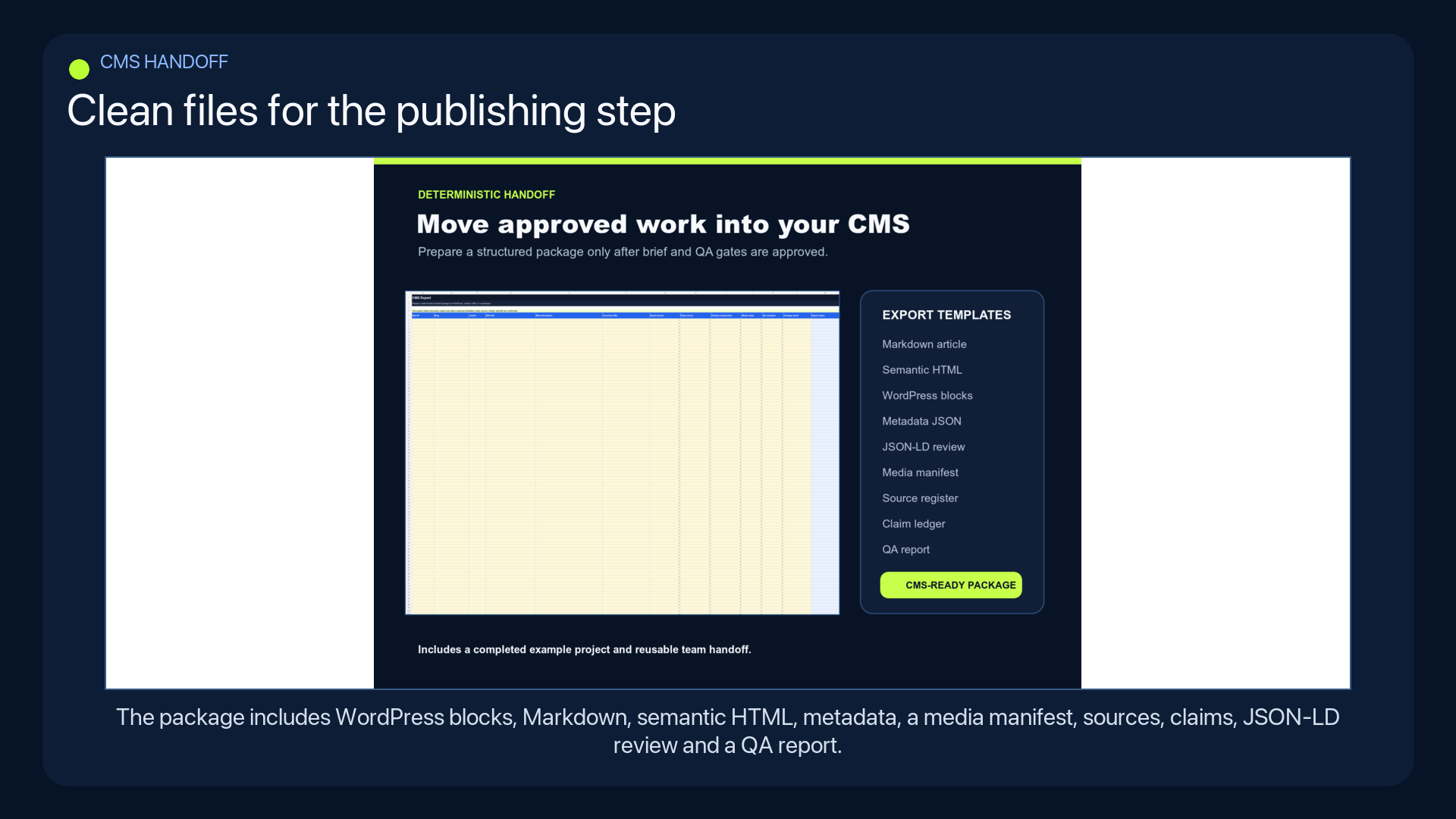
The final handoff contains the reviewed Markdown, the source log, open issues, and serialized Gutenberg content. WordPress documents that blocks are stored using HTML comment delimiters and parsed into editable blocks by the editor.
A heading in the handoff therefore looks like this in post_content: <!-- wp:heading -->, followed by the H2 element, followed by <!-- /wp:heading -->.
The handoff record for this demonstration contains:
| Deliverable | Status |
|---|---|
| Editorial brief | Approved for drafting |
| Source log | Two primary documentation sets reviewed on 2026-10-28 |
| Markdown source | Complete |
| Unsupported ranking claim | Rejected and corrected |
| Gutenberg blocks | Generated and parser-checked |
| Featured image and screenshots | Attached to the WordPress draft; final preview still pending |
| WordPress status | Draft only |
| Publication approval | Not granted |
This table records the demonstration’s pre-publication checkpoint. A later owner approval is a separate workflow state, not a retroactive change to the handoff record.
Keeping publication approval separate from draft import is important. A technically valid block document may still have unresolved editorial or visual work.
What This Workflow Can and Cannot Prove
This process can show which brief, sources, prompt, edits, checks, and output created a draft. It makes unsupported claims easier to identify and gives a team a repeatable handoff format.
It cannot prove that an article is helpful merely because every field is filled in. It cannot guarantee rankings, traffic, conversions, AI citations, or inclusion in an AI Overview. It cannot manufacture first-hand experience or replace a qualified reviewer for legal, medical, financial, or other high-stakes topics.
The method also does not make a model deterministic. A later run may produce different text. Preserve accepted inputs and human decisions rather than treating the chat history as the only record.
A Reusable Pre-Publication Handoff Checklist
Before a draft leaves the workflow, confirm that:
- the reader, task, scope, and owner are explicit;
- every consequential claim has a checked source or a visible verification flag;
- model output has been reviewed line by line where accuracy matters;
- unsupported claims and their corrections are recorded;
- the title, excerpt, headings, internal links, and limitations match the brief;
- the CMS body uses editable blocks and does not duplicate the template H1;
- the real preview has been checked on desktop, mobile, and keyboard;
- unresolved assets and decisions are listed;
- the WordPress status is
draftuntil the owner approves publication.
Frequently Asked Questions
Does an evidence log stop AI hallucinations?
No. It defines the material the model is allowed to use and makes review more concrete. The model can still misread, combine, or invent details, so a human must compare important claims with the sources.
Can the workflow publish directly to WordPress?
It can produce block markup suitable for an import process, but automatic publication is a separate product and risk decision. In this demonstration, the importer creates a draft and verifies the saved status. The owner publishes only after review.
Is a content score part of the process?
No fictional overall score is required. The workflow records observable checks, accepted changes, open questions, and reviewer responsibility. That is more useful than hiding unlike decisions inside one percentage.
Does clean Gutenberg markup improve rankings?
Not by itself. Block markup keeps the post editable and predictable inside WordPress. Search performance depends on many factors beyond the storage format.
Sources and Review Date
Sources reviewed on 28 October 2026:
- Creating helpful, reliable, people-first content, Google Search Central.
- Markup representation of a block, WordPress Developer Resources.
- Data Flow and Data Format, WordPress Developer Resources.
Verification Notes
- Not verified: any ranking, traffic, conversion, or AI citation improvement from using this workflow.
- The project is a demonstration produced for TomSEOTools, not a customer case study.
- Included assets: a branded OG card and three product workflow screenshots covering the brief, evidence review, and CMS handoff.
- Not verified: the final rendered WordPress preview; the owner should check it before publication.