
There is no reliable formatting trick that makes an AI system cite a page. No third-party checker can see Google’s internal retrieval systems, and no special “AI schema” creates authority.
There is still useful work to do.
A page with clear sections, explicit entities, direct explanations, nearby evidence, and little template noise is easier for people to navigate. It is also easier to split into passages that retain their meaning outside the full document. I call that extractability — a content property, not a ranking promise.
Google’s current guidance for generative AI features says ordinary SEO foundations still apply. Google does not require special AI files, special schema or another machine-readable format for inclusion in AI Overviews or AI Mode. The page must be indexed and eligible to appear with a snippet, but eligibility does not guarantee inclusion. The goal should still be useful, original material for the visitor.
What extractability means
An extractable section can be separated from the surrounding page and still answer three questions:
- What subject or entity is this about?
- What question does this section answer?
- What context or evidence is required to use the answer correctly?
For example, the sentence “It supports 20 files” is ambiguous when removed from its page. “TomSEOTools PDF Merger accepts up to 20 local PDF files per merge” keeps the entity, limit, and task together.
This does not mean repeating the product name in every paragraph. It means avoiding pronouns and fragments where a section depends entirely on text far above it.
A practical extractability workflow
The workflow below reviews qualities that can be observed on the rendered page. It does not attempt to score private retrieval systems or simulate an AI citation decision.
1. Give the page one clear job
Write the page purpose in one sentence. If the page is simultaneously a product page, general glossary, company history, and ten unrelated tutorials, a retrieval system is not the only reader who will struggle.
Related subtopics can live together. The important point is that they support the same primary task.
2. Use headings that describe the section
“How structural PDF compression works” is more useful than “More information”. A descriptive heading gives readers a reliable map and lets an extracted passage carry part of its own context.
Do not turn every heading into a question merely because question headings are easy to recognize. Use them when a person genuinely asks that question. Use statements, comparisons, steps, and warnings when those structures are clearer.
3. Answer early, then add the conditions
For a definition or common question, begin with a concise answer. Follow it with the cases, limits, and evidence that prevent the answer from becoming misleading.
Weak opening:
In today’s rapidly changing digital landscape, there are many things to consider when working with PDF documents.
Stronger opening:
Structural PDF compression removes redundant objects without turning each page into an image. It can preserve selectable text and vectors, but an already optimized file may not become smaller.
The second version is not “written for AI”. It simply respects the reader’s time.
4. Keep the entity explicit where ambiguity matters
Use the full name at the start of an important section, comparison, or table. Then use natural shorter references. This is especially useful when several tools, models, companies, or standards appear on one page.
Structured data can describe the same real entity, but it is not required for AI visibility and should never contradict visible content.
5. Put evidence beside the claim
If a paragraph gives a number, benchmark, policy, compatibility statement, or health recommendation, place its source or test method nearby.
A list of references at the bottom is better than nothing, but it makes verification harder. Readers should be able to see why a link is present and which statement it supports.
6. Remove template noise from the main path
Repeated navigation, promotional blocks, unrelated widgets, and aggressive ads can interrupt the reading sequence. This is not an argument for hiding necessary navigation. It is an argument for a clear main-content region and a sensible visual hierarchy.
7. Use tables only when relationships matter
A table is useful for repeated fields such as mode, input, output, limitation, and best use. Do not force prose into a table merely to look machine-readable.
The same applies to lists. A list should represent a real set or sequence, not break every sentence into a bullet.
8. Preserve nuance instead of over-chunking
Google explicitly says there is no requirement to split content into tiny pieces for generative AI Search. A section should be as long as needed to complete one coherent job.
Split when the subject changes. Keep paragraphs together when separating them would remove a condition, warning, or explanation.
9. Add original evidence
Screenshots, measured outputs, test fixtures, downloadable examples, change logs, and failure cases give a page information that is not a generic rewrite of existing results.
This is also where AI-assisted drafts often fail. A fluent summary can still be commodity content. The valuable layer is the part produced by real testing, experience, analysis, or reporting.
10. Review the final rendered page
Do not audit only the text document. Check the final page after the CMS, theme, and scripts have rendered it. Confirm that headings are in order, source links work, hidden content is not carrying essential meaning, and the important answer is visible without interaction.
The AI Extractability Checker can review pasted rendered HTML or visible text locally. It reports structural observations and excerpts; it does not fetch a URL, execute scripts, upload the content, or predict citations.
Use a Real Input, Not a Vague Score
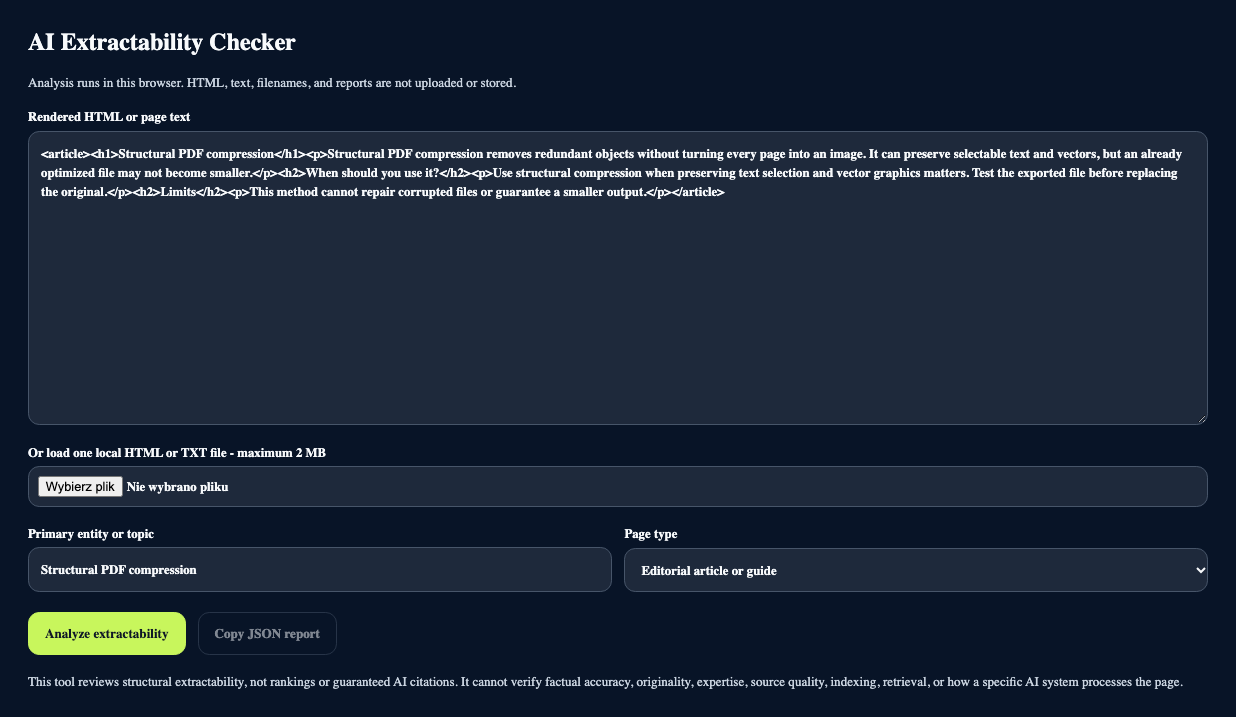
Start with the final visible text or rendered HTML from the page you actually plan to publish. Name the primary entity or topic and choose the closest page type. The public example below uses a synthetic explanation of structural PDF compression; it is not copied from a live customer page.
A generic score without the inspected passage is hard to challenge. A useful review should preserve the input, the detected structure and the exact excerpt behind each finding. That makes the result suitable for editorial discussion instead of turning it into another unexplained SEO grade.
Read Findings as Evidence, Not a Verdict
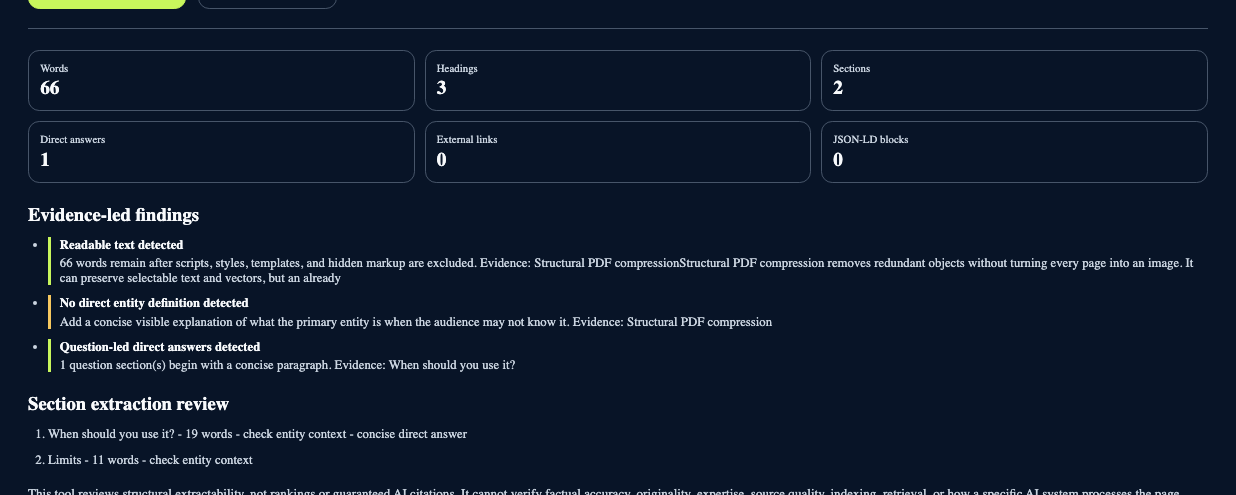
The checker reports observable features such as readable text, headings, direct-answer patterns, external links and JSON-LD blocks. It also shows excerpts so an editor can decide whether the finding is meaningful.
| Finding | What it can support | What it cannot prove |
|---|---|---|
| Readable text detected | Important content is available in the supplied input | A crawler indexed or trusted the page |
| Clear section headings | The document has a navigable outline | The sections match search demand |
| Direct-answer pattern | A question is followed by a concise passage | An AI system will quote or cite it |
| Entity context warning | A passage may be ambiguous when separated | Repeating the entity will improve ranking |
| Source or link observation | Evidence links are present in the input | The sources are correct or authoritative |
Use the report to locate passages worth reviewing, then make an editorial decision. A warning can be accepted when the surrounding context already resolves it. A passing observation can still hide weak evidence, stale instructions or an unhelpful page purpose.
What not to do
- Do not create dozens of pages for slight variations of the same question.
- Do not add an “AI-ready” schema type that does not exist.
- Do not rewrite every heading as a keyword-heavy question.
- Do not repeat the brand or entity name unnaturally in every paragraph.
- Do not cite weak sources merely to increase the number of links.
- Do not claim that an optional AI-focused file replaces crawlable, useful HTML or Google Search requirements.
- Do not treat a heuristic checker as evidence that an AI system will retrieve or trust the page.
Before-and-after example
Before:
Our tool is fast and secure. It gives you good results and works locally. This is important for privacy and is better than many alternatives.
After:
TomSEOTools Text Character Counter calculates characters, words, whitespace, paragraphs, and an approximate page count inside the browser. The page makes no upload or storage request. Its character metric uses Unicode code points, so a combined emoji can still count as more than one user-perceived character.
The improved version names the entity, describes the operation, states the privacy boundary, and includes a real limitation. It is more useful even if no AI feature ever cites it.
Editorial checklist
Before publishing, check that:
- the title and H1 describe the same primary task;
- each important section has a descriptive heading;
- a direct answer appears near the start when the intent calls for one;
- the subject remains clear when a section is read alone;
- numbers and consequential claims have nearby evidence;
- author, update, disclosure, and limitation information is visible where relevant;
- examples come from real inputs or tests;
- template blocks do not interrupt the primary task;
- internal links continue the reader’s workflow;
- the final rendered page works on mobile and with a keyboard.
Frequently asked questions
Does extractable content guarantee an AI citation?
No. Retrieval and citation depend on systems and signals a page-level checker cannot observe. Extractability is a way to improve clarity and review structural gaps.
Is structured data required for AI search?
No. Google says structured data is not required for generative AI search and there is no special schema for it. Valid markup remains useful for supported Search features and entity clarity when it matches the visible page.
Should every section start with a short answer?
No. It is helpful for definitions and direct questions. Case studies, narratives, warnings, and complex explanations may need a different structure.
How long should an extractable section be?
There is no universal word count. Split a section when its subject or task changes, not to satisfy an invented AI limit.
Sources
- Google Search Central: AI features and your website
- Google Search Central: Creating helpful, reliable, people-first content
- Google Search Central: Guidance on generative AI content
- W3C WAI: Headings and page structure
Source review date: 27 October 2026. The workflow was checked against the current local TomSEOTools interface with synthetic example content. It does not predict indexing, retrieval, rankings or citations.